Breaking News

Trump Signals Trade Deal Uncertainty with Canada Following Palestinian Statehood Announcement

Download IPFS

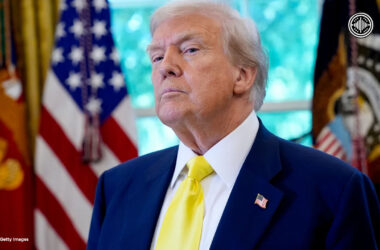
Former U.S. President Donald Trump stated Thursday that it would be “very hard” to finalize a trade agreement with Canada after the Canadian government announced plans to support the recognition of a Palestinian state. The remarks came just hours before the United States imposed increased tariffs on specific Canadian imports.

Posting shortly after midnight on Truth Social, Trump reacted to Canada’s foreign policy shift, writing: “Wow! Canada has just announced that it is backing statehood for Palestine. That will make it very hard for us to make a Trade Deal with them.” Later that day, the White House confirmed a tariff increase from 25% to 35% on several Canadian goods, effective the following day.

Canadian Prime Minister Mark Carney had announced on Wednesday that Canada would move to formally recognize Palestinian statehood at the United Nations General Assembly in September, contingent on the Palestinian Authority enacting democratic reforms, including elections in 2026 without participation from Hamas, a U.S.-designated terrorist organization.

While the White House’s tariff announcement made no direct reference to Canada’s stance on Middle East policy or the ongoing conflict between Israel and Hamas in Gaza, the timing appeared closely linked. Canada is now the third member of the Group of Seven (G7) industrialized nations, following France and the United Kingdom, to support Palestinian statehood in recent days.

Trump previously finalized a trade agreement with the European Union (EU), which includes countries such as France that have taken a similar position on the Israeli–Palestinian issue. However, in the case of Canada, the former president indicated that foreign policy choices may complicate economic negotiations. In July, Trump had already threatened additional tariffs on Canada, citing what he described as growing concerns over illegal drug smuggling, specifically fentanyl.

Under the current tariff structure, goods compliant with the United States–Mexico–Canada Agreement (USMCA) remain exempt. According to the U.S. Commerce Department, roughly 60% of U.S. imports from Canada met USMCA criteria as of May, a notable increase from 34% earlier in the year. Goods outside the agreement, however, have been subject to escalating tariffs, including on steel, aluminum, and vehicles.

Carney, who became leader of Canada’s Liberal Party in March and won an election in April, has taken a combative stance on U.S.-Canada relations under Trump. During his campaign, Carney declared the traditional bilateral relationship “over” and pledged to push back with retaliatory tariffs if needed. He has also criticized Trump’s comments about potentially annexing Canada, stating emphatically that his country “is not for sale.”

Despite recent efforts by Canadian officials to smooth relations, tensions have persisted. In June, Trump halted talks over Canada’s digital services tax, labeling it a “direct and blatant attack” on American interests. Although Ottawa later dropped the proposed tax, the disruption contributed to growing friction in trade negotiations.

The Canadian government’s recognition of Palestinian statehood has sparked global debate. The Palestinian Authority praised the move as “courageous” and a meaningful step toward self-determination. Israel, by contrast, condemned the announcement as a “reward for Hamas” and a setback to diplomatic efforts aimed at ending the war and securing the release of hostages.

In remarks earlier this week, Trump acknowledged the worsening conditions in Gaza, referring to “real starvation” in the region, an apparent divergence from Israeli Prime Minister Benjamin Netanyahu’s denial of a humanitarian crisis. Still, Trump has maintained a skeptical view of recognizing Palestinian statehood, warning that it risks legitimizing Hamas, which continues to hold power in Gaza.

As the diplomatic and economic stakes rise, the future of U.S.-Canada trade relations remains uncertain, with political differences increasingly influencing the trajectory of bilateral agreements.

Leave a Comment

Your email address will not be published. Required fields are marked *

*

OPENVC Logo OpenVoiceCoin $0.00
OPENVC

Latest Market Prices

Bitcoin

Bitcoin

$67,873.92

BTC -1.50%

Ethereum

Ethereum

$2,034.07

ETH -2.83%

NEO

NEO

$2.59

NEO -1.44%

Waves

Waves

$0.43

WAVES -2.46%

Monero

Monero

$355.78

XMR 4.08%

Nano

Nano

$0.45

NANO -4.19%

ARK

ARK

$0.16

ARK -3.05%

Pirate Chain

Pirate Chain

$0.22

ARRR -3.13%

Dogecoin

Dogecoin

$0.09

DOGE -1.40%

Litecoin

Litecoin

$53.44

LTC -1.79%

Cardano

Cardano

$0.25

ADA -3.09%

Subscribe to Blog via Email

Enter your email address to subscribe to this blog and receive notifications of new posts by email.